
Lights left burning in empty rooms are one of the simplest forms of energy waste, at home and in business. Motion sensors tackle this by switching lights on only when someone is there and off again when they leave. But do they really make a difference, and where are they worth installing? The short answer is yes, in the right places, and they work particularly well with LED lighting.
How motion sensors work
A lighting sensor detects occupancy and switches or dims the lights connected to it. Most use one of these technologies:
- Passive infrared (PIR): detects the heat signature of a moving person. PIR sensors are reliable, affordable and the most common choice for homes, corridors and outdoor lights. They need a reasonably clear line of sight.
- Microwave (radar): sends out a low-power signal and detects movement from the reflection. Microwave sensors are more sensitive, can detect small movements and can sometimes “see” through thin partitions or diffusers, which makes them popular inside luminaires such as high-bays and bulkhead fittings.
- Dual-technology: combines two methods to reduce false triggering, often used in offices and classrooms.
Key settings
Most sensors let you adjust three things:
- Time delay: how long the light stays on after the last movement is detected.
- Sensitivity or range: how far and how finely the sensor detects movement.
- Light level (lux) threshold: the sensor only switches the lights on when it is darker than the level you set, so they stay off when there is enough daylight.
In larger buildings, sensors can also be connected to a control system such as DALI, where settings are programmed through software and lights can dim to a low background level rather than switching off completely.
Presence detection vs absence detection
There are two ways to use occupancy sensing, and the choice affects how much energy you save.
Presence detection (automatic on, automatic off)
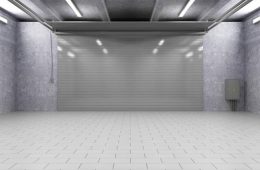
The light switches on as soon as someone enters and off after the time delay. This is ideal for corridors, stairwells, toilets, store rooms, garages and entrances, where people pass through with their hands full or would simply forget the switch.
Absence detection (manual on, automatic off)
The user switches the light on manually, but the sensor turns it off when the room is empty. This often saves more energy in offices, meeting rooms and classrooms, because lights are not switched on unnecessarily when daylight is already adequate or someone just walks in briefly. You can, of course, still switch the light off yourself.
Where motion sensors save the most
Sensors deliver the biggest savings in spaces that are used intermittently but would otherwise be lit all day:
- Corridors, lobbies and stairwells in apartment blocks and offices
- Toilets and washrooms
- Store rooms, archives and plant rooms
- Warehouse aisles, loading bays and car parks
- Garages and utility rooms at home
- Outdoor entrances, driveways and side passages
In an open-plan office or a busy shop that is occupied all day, a simple motion sensor will save little. There, daylight sensing and dimming usually make more of a difference.
Daylight sensing
Many advanced sensors include a photocell that measures the light already in the room. In daylight-linked control, the system dims the artificial lighting when plenty of daylight comes in through windows or rooflights, and raises it again as daylight fades, keeping a steady light level throughout the day. Combined with presence detection, this can noticeably reduce consumption in offices, schools and warehouses with good natural light.
Why sensors and LED work so well together
Older fluorescent tubes did not like frequent switching: it shortened their life, and they took time to reach full brightness. LED fittings switch on instantly at full output and handle frequent on/off cycles much better, so they pair naturally with sensors. LEDs also dim smoothly, which allows a “corridor function” where lights drop to a low level when an area is empty rather than going completely dark.
The combination is powerful: switching to LED cuts the power each fitting uses, and sensors cut the hours it is on. Together they can reduce lighting energy far more than either measure alone.
Tips for getting it right
- Position carefully: PIR sensors detect movement across their field of view better than movement straight towards them. Avoid pointing them at heat sources, air-conditioning outlets or busy public pavements.
- Set a sensible time delay: too short and people end up waving their arms in the dark; too long and savings shrink. A few minutes is typical for corridors.
- Check compatibility: make sure the sensor is rated for LED loads and for the number of fittings it will switch.
- Use the right IP rating outdoors: exterior sensors must be weatherproof and positioned away from trees and shrubs that move in the wind.
- Consider safety: on escape routes and stairs, lights should never leave someone stranded in darkness. Emergency lighting remains a separate requirement.
Options for homes and outdoor areas
At home, sensors are most useful in garages, utility rooms, walk-in wardrobes and outside the front door. Soffit-mounted sensors and solar-powered motion lights are convenient for exterior walls and gardens where running cables is difficult. If you are improving a garage, see our tips for better garage lighting, and for wider smart control at home, take a look at iotty smart switches.
LTC LED Lighting in Naxxar supplies motion sensors that can be adjusted to suit each space, including soffit and solar options for outdoor use. For commercial and industrial buildings, RG Alternatives can assess where sensors and daylight controls will pay off and design them into your LED upgrade. Talk to our lighting consultancy team to find out more.