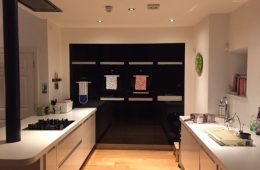

The GU10 is one of the most common spotlight bulbs in homes and businesses across Malta. You will find it in kitchen ceilings, gypsum soffits, track lights, wall spots and display cabinets: anywhere a bright, directional beam is needed. If you are replacing a bulb or planning a new installation, it helps to know exactly what a GU10 is and how to choose a good LED version.
What does “GU10” mean?
“GU10” describes the cap, or base, of the bulb rather than its shape or brightness. A GU10 bulb has two short, thick pins with flattened ends, spaced 10 mm apart. You fit it by pushing it into the holder and giving it a quarter turn, which locks it in place. That twist-lock design is why GU10 holders are so popular in ceiling fittings: the bulb cannot simply drop out.
GU10 bulbs run directly on mains voltage (230V in Malta), so they do not need a separate transformer. Most have the classic spotlight shape, narrow at the base and widening to a flat front about 50 mm across. This shape is sometimes referred to as PAR16, after the older reflector lamp it resembles.
GU10 vs MR16 and GU5.3
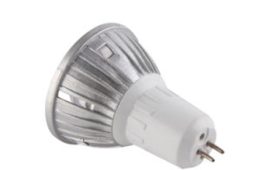
The bulb most often confused with a GU10 is the MR16. From the front they look almost identical, but an MR16 has two thin, needle-like pins (a GU5.3 base) and normally runs on 12V through a transformer or driver. The two are not interchangeable:
- GU10: thick, twist-lock pins, mains voltage, no transformer.
- MR16 / GU5.3: thin push-in pins, low voltage, needs a compatible transformer or LED driver.
If you are unsure what you have, switch off the power, remove the bulb and look at the pins. Many people take the old bulb with them to the shop, which is always a sensible idea.
Long-barrel GU10s
Some furniture, cabinet and decorative fittings are designed for “long-barrel” GU10s, which are around 75 mm long compared with roughly 50–55 mm for a standard bulb. If a standard GU10 sits too far back in a deep fitting, or a long one protrudes from a shallow one, check the length before buying.
What happened to halogen GU10s?
For years, GU10s were halogen bulbs, typically 35W or 50W. They gave a pleasant light but wasted most of their energy as heat and lasted only a couple of thousand hours. Under EU ecodesign rules, mains-voltage halogen reflector lamps such as the GU10 were phased out of sale from September 2016. Low-voltage halogen capsules and spots have since largely followed.
Compact fluorescent (CFL) GU10s were briefly sold as an alternative, but they were bulky, slow to reach full brightness and contained mercury. They have now been withdrawn from the EU market as well. Today, LED is effectively the only practical choice for GU10 fittings, and fortunately it is a very good one.
Why choose LED GU10s?
Modern LED GU10s are designed to look like the halogen bulbs they replace, and many now have glass bodies that are almost indistinguishable from the originals. The advantages are considerable:
- Lower energy use: an LED GU10 typically uses around a tenth of the power of the halogen bulb it replaces for similar brightness.
- Longer life: good-quality LED GU10s are commonly rated for 15,000–25,000 hours or more, compared with about 2,000 hours for halogen.
- Less heat: far less heat goes into your ceiling void, fittings and room, which matters during a Maltese summer.
- Choice of colour: LED GU10s are available in warm, neutral and cool white, and in tunable or smart versions.
How to choose the right LED GU10
Brightness: look at lumens, not watts
Watts tell you how much power a bulb uses, not how much light it gives. Compare bulbs by lumens instead. As a rough guide, a 50W halogen GU10 produced somewhere around 350–450 lumens, so look for an LED with a similar or slightly higher figure if you want the same brightness. We cover this in more detail in our article on common mistakes to avoid when upgrading to LED.
Colour temperature
Colour temperature is measured in Kelvin (K). Around 3000K is a warm white suited to living rooms and bedrooms, 4000K is a neutral white that works well in kitchens, bathrooms and offices, and 5000–6000K is a cool, daylight-type white often used in garages, workshops and some commercial spaces. Our guide to 3000K vs 4000K vs 5000K explains how to choose.
Beam angle
Beam angle controls how widely the light spreads. A narrow beam (around 24–36 degrees) creates pools of light for highlighting artwork or display items. A wider beam (around 60 degrees or more) gives more even general lighting, which is usually better for ceiling downlights in living areas and kitchens.
Colour rendering
Colour Rendering Index (CRI) indicates how naturally colours appear under the light. A CRI of 80 or more is fine for most rooms; CRI 90 or above is worth considering for kitchens, dressing areas, shops and anywhere colour accuracy matters.
Dimming
Not every LED GU10 is dimmable. If your spotlights are on a dimmer, choose bulbs clearly marked as dimmable and check that the dimmer is suitable for LED loads. An old dimmer designed for halogen can cause flicker, buzzing or a limited dimming range.
Fitting and safety tips
- Always switch off the power before changing a bulb, and let any old halogen bulbs cool first.
- In bathrooms and outdoors, use fittings with a suitable IP rating for the location.
- Some fully enclosed fittings trap heat; LED bulbs last longest with a little ventilation around them.
- When replacing a whole room of spotlights, buy from the same product line so colour and brightness match.
LTC LED Lighting, our showroom in Naxxar, stocks LED GU10 bulbs in a choice of colour temperatures, including dimmable versions, together with soffit and spotlight fittings to suit them. If you are planning a larger project or would like advice on the right beam angle and layout for a space, get in touch with RG Alternatives and our team will be happy to help.