
You often read that LED lights do not get hot, but that is not entirely true. LEDs feel much cooler than halogen or incandescent bulbs, and they are far safer to touch, but they do produce heat, as every light source does. Understanding where that heat comes from and how it is managed explains a lot about why LEDs last so long, and why good-quality LEDs outlast cheap ones.
Why do lights produce heat?
Every light source converts electrical energy into two things: visible light and heat. The difference between technologies lies in how much of each they produce, and in what form.
Incandescent and halogen bulbs work by heating a filament until it glows. Only a small fraction of the energy, typically less than a tenth, becomes visible light. The rest is given off as heat, most of it as infrared radiation that shoots out of the front of the bulb along with the light. That is why a halogen spotlight feels hot on your skin and why the bulb itself becomes too hot to touch.
Fluorescent lamps are more efficient but still waste a good deal of energy as heat.
How LEDs are different
LEDs produce light in a completely different way, by passing current through a semiconductor. They are considerably more efficient, so for the same amount of light, they use far less power and produce far less heat overall.
Two other differences matter:
- Little infrared in the beam: LEDs used for general lighting emit almost no infrared radiation in their light output, so objects lit by an LED do not heat up the way they do under a halogen spotlight. This is one reason LEDs are popular for lighting food displays, artwork and delicate materials.
- Heat stays at the back: even efficient white LEDs still convert only part of their energy into light, typically well under half. The rest becomes heat at the LED chip itself. Instead of radiating forward, this heat has to be conducted away through the back of the LED.
So an LED does not get hot in front, but it does generate heat behind the light, and that heat has to go somewhere.
How LEDs release heat: the heat sink
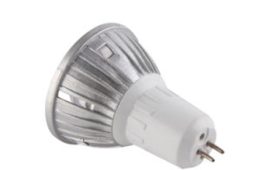
This is the job of the heat sink. A heat sink draws heat away from the LED chip and releases it into the surrounding air. On LED bulbs, it is often the metal or ceramic-coated body of the bulb, sometimes with fins. On larger fittings such as high-bays, floodlights and street lights, it is usually a substantial aluminium body with fins designed to maximise surface area.
LED strip lights have many small, low-power LEDs spread out along the strip, so heat per LED is low. Even so, mounting strips on an aluminium profile helps keep them cool and extends their life, particularly for brighter strips.
The heat sink is the part of an LED fitting that does get warm, and on powerful fittings it can be hot. Avoid touching it while the light is on, and let it cool before handling.
The quality of the heat sink, how well it is connected to the LED, and the conductivity of the materials used all determine how effectively heat is removed. This is one of the main differences between well-engineered and cheap LED products.
Heat and LED lifespan
Heat is the biggest factor in how long an LED lasts. The temperature at the LED chip, called the junction temperature, determines how quickly the LED degrades. A well-designed fitting keeps the junction temperature low, so the LED ages slowly. A poorly designed one runs hot and loses brightness much faster. Heat also affects the driver electronics, which are often the first part to fail in a cheap product.
LEDs fade rather than fail
Unlike incandescent and halogen bulbs, whose filaments eventually burn through, LEDs rarely fail suddenly. Instead, their light output gradually declines over time. An LED’s rated lifespan is usually given as the number of hours until it reaches 70% of its original output, known as L70. A light used for long hours every day, such as an LED tube in a factory running two shifts, reaches this point sooner in calendar terms than one used for a few hours in the evening. Technically the LED still works beyond its rated life, but it gives less light.
We explain lifespan ratings further in our article What is so special about LED bulbs?
Practical tips
- Check enclosed fittings: some LED bulbs are not designed for fully enclosed fittings, where heat builds up. Look for bulbs rated for enclosed use if needed.
- Leave space around downlights and drivers: avoid burying them in insulation or packing them into tight voids unless they are designed for it.
- Consider the ambient temperature: Malta’s summers can make ceiling voids, kitchens and outdoor fittings very warm. Products with good thermal design cope much better.
- Choose quality: a reputable product with a solid heat sink will last far longer than a lightweight bargain.
- Enjoy the cooler room: replacing many halogen spots with LED reduces the heat they add to a room, which can help a little with air-conditioning load in summer.
The answer
LEDs do produce heat, but much less than traditional lighting, and they manage it differently. The light itself is cool, and the heat is drawn away at the back through the heat sink. That careful heat management is exactly what allows LEDs to last so much longer. For more on fitting choices, see our guide to GU10 bulbs.
LTC LED Lighting in St Paul Street, Naxxar, stocks LED bulbs, strip lights and fittings designed for good thermal performance. For commercial and industrial projects, where heat and long operating hours are a major consideration, RG Alternatives can recommend the right fittings. Contact us to discuss your requirements.