
You have probably heard that LED lights are cheaper to run than any other type of lighting. It is true, but how much you actually save depends on what you are replacing, how long the lights are on and what you pay for electricity. Rather than quoting a single figure that may not apply to you, this article shows you how to work out the saving for your own home or business. All you need is three numbers and a calculator.
Purchase price versus running cost
When buying a bulb, most people look at the price on the shelf. An LED may cost more to buy than a halogen or incandescent bulb, and if that is the only cost you consider, the older bulb looks cheaper.
But the purchase price is only a small part of the story. Over its life, a bulb usually costs far more in electricity than it did to buy. LEDs typically use around 75–85% less energy than incandescent and halogen bulbs for similar light, and they last many times longer, so you buy fewer replacements. When you take both into account, LEDs almost always work out cheaper overall.
The three numbers you need
- Wattage (W). The power the bulb or fitting consumes, printed on the bulb, the box or the product information. For fluorescent fittings, remember that the ballast also uses some power.
- Hours of use per year. Estimate how many hours a day the light is on, then multiply by the number of days. A light used 3 hours a day, every day, runs for about 1,095 hours a year.
- Your electricity rate (€ per kWh). Check your electricity bill. In Malta, residential tariffs are charged in bands, so the price per unit rises as your annual consumption increases, and business tariffs are structured differently. Use the rate that applies to your consumption.
The calculation
Energy used per year (kWh) = wattage × hours per year ÷ 1,000
Running cost per year (€) = kWh × your price per kWh
Do this for your current bulb and for the LED replacement. The difference is your annual energy saving.
Worked example: a kitchen with halogen spotlights
The following numbers are hypothetical, chosen only to illustrate the method.
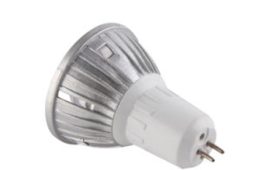
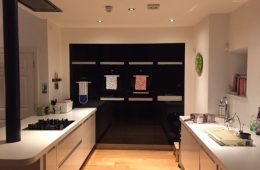
Imagine a kitchen with ten 50W halogen GU10 spotlights, used for 4 hours a day, every day. You replace them with 5W LED GU10s giving a similar light output. Assume electricity costs €0.15 per kWh.
- Hours per year: 4 × 365 = 1,460 hours
- Halogen: 50W × 1,460 ÷ 1,000 = 73 kWh per bulb per year, or 730 kWh for ten bulbs
- LED: 5W × 1,460 ÷ 1,000 = 7.3 kWh per bulb per year, or 73 kWh for ten bulbs
- Energy saved: 730 − 73 = 657 kWh per year
- Money saved: 657 × €0.15 = about €98.55 per year
In this example, ten spotlights save close to €100 a year in electricity alone. Halogen lamps also need replacing far more often, typically after 2,000 to 4,000 hours, compared with LEDs that are commonly rated for 15,000 hours or more, so there are additional savings on replacement bulbs. For more on these spotlights, see our article on the GU10 bulb.
Worked example: a small business with fluorescent tubes
Again, these figures are hypothetical.
A workshop has 100 fluorescent fittings, each drawing 45W including the ballast. They are replaced with LED fittings drawing 18W each. The lights run 12 hours a day, 300 days a year, and electricity costs €0.20 per kWh.
- Hours per year: 12 × 300 = 3,600 hours
- Power saved: (45W − 18W) × 100 fittings = 2,700W, or 2.7 kW
- Energy saved: 2.7 kW × 3,600 hours = 9,720 kWh per year
- Money saved: 9,720 × €0.20 = €1,944 per year
For businesses with hundreds or thousands of fittings, long operating hours and high-ceiling maintenance costs, the numbers grow quickly. LED T8 and T5 tubes and tri-proof fittings are a common replacement for fluorescent lighting in these settings.
Working out the payback period
Once you know the annual saving, divide the cost of the upgrade by it:
Payback (years) = cost of the LED upgrade ÷ annual saving
For a more complete picture, add the avoided cost of replacement lamps and maintenance labour to the annual saving. For businesses, reduced heat from lighting may also lower air-conditioning costs.
Ways to save even more
- Replace the lights that are on longest first, as they deliver the biggest savings.
- Add motion sensors in corridors, stores and toilets, and timers or photocells on outdoor lights.
- Do not over-light. Choose the right brightness for each space rather than the highest-wattage fitting.
- Choose quality products. A cheap LED that fails early or flickers will not deliver the expected savings.
For more everyday tips, read our article on ways to save energy and money.
Get a precise figure for your premises
For homes, the calculation above is usually all you need. For commercial and industrial premises, the same calculation applies, using your actual fittings, operating hours and tariff. RG Alternatives can also prepare a lighting design to make sure the new system delivers the right light levels. Talk to us about LED lighting consultancy.