
Track lighting is one of the most flexible ways to light a room. Instead of a single fixed fitting, a track carries several light heads that can be positioned anywhere along its length and aimed in different directions. Once used mainly in shops and galleries, it is now a popular choice in homes, from kitchens and corridors to living rooms and even bedrooms. Its clean, contemporary look makes it particularly well suited to new builds and renovations. LTC LED Lighting in Naxxar supplies track lighting for homes and businesses, and this guide explains how it works and how to use it well.
How track lighting works
A track lighting system has two main parts:
- The track: a slim rail, usually aluminium, that carries power along its length. It can be surface-mounted to the ceiling, suspended on wires or rods, recessed into a gypsum ceiling for a flush finish, or fixed to a wall or beam.
- The heads: spotlights or pendants that clip into the track. They can be slid along, rotated and tilted, added or removed as your needs change.
Tracks come in different types, so heads and accessories must match the system. Single-circuit tracks switch all heads together, while multi-circuit tracks allow groups of heads to be switched separately. Modern LED track heads are available with different beam angles, colour temperatures and finishes, and many are dimmable.
Why choose track lighting?
- Flexibility. Move and re-aim heads whenever you rearrange furniture, change artwork or update a display.
- Accent and task in one. The same track can highlight a picture, light a worktop and provide general light.
- Easier installation. A track can often be connected to an existing ceiling light point, so you can add several light sources without chasing new cables into finished walls and ceilings. Your electrician will confirm what is possible in your home.
- Good for high ceilings. Suspended tracks bring light closer to where it is needed, and look natural hanging from a high ceiling in a way some fittings do not.
- Efficient. LED track heads put light exactly where you want it, using far less energy than older halogen spotlights.
Where to use track lighting at home
Corridors
Long, narrow corridors often look patchy when lit only by one or two ceiling fittings, with bright spots under each light and dark stretches between them. A track with evenly spaced heads gives a more uniform level of light along the whole length. If you use your corridor to display artwork or family photographs, angle the heads to highlight each piece and turn a functional space into a gallery.
Kitchens and workspaces
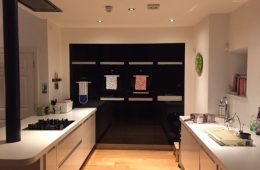
In a work area, one or two bright fittings tend to cast shadows as you lean over the counter. Several light sources from a track, aimed at the worktops from different angles, reduce shadowing and make food preparation easier and safer. The same applies to workshops, hobby rooms and home offices, where a directional head can keep a desk well lit.
Living rooms
Track lighting suits living rooms well because it can provide accent and general lighting at the same time. Aim some heads at shelving, display units or objets d’art, and others at walls or the ceiling to bounce soft light into the room. Add dimming and you can move easily from a bright setting for reading or tidying to a relaxed setting for the evening.
Bedroom accent walls
Track lighting is not an obvious choice for a bedroom, where most people want a calm, subdued atmosphere. The trick is to use it indirectly. Aim the heads at a feature wall, a headboard or a display cabinet so light reflects softly back into the room, rather than pointing them at the bed. Choose warm white heads and a dimmable system for full control over the mood.
Irregular rooms
Track lighting is not limited to straight lines. Many systems include corner connectors and flexible connectors, and some tracks can be curved, so they can follow the shape of an irregular room, a curved wall or an open-plan layout that would be difficult to light evenly with standard fittings.
Beams and high roofs
Tracks do not have to be mounted on a flat ceiling. They can be fixed along exposed beams, mounted on walls or suspended within pitched roofs, which works well in converted townhouses and farmhouses with high ceilings or visible roof structures.
Tips for getting it right
- Avoid glare. Aim heads at objects and surfaces, not into people’s eyes, especially over seating and dining areas.
- Mix beam angles. Narrow beams for accent lighting, wider beams for general light.
- Keep a consistent colour temperature within a room.
- Choose quality heads with good colour rendering, so artwork, food and finishes look natural.
- Match the system: heads and connectors must be compatible with your track type.
Track lighting is especially useful in compact homes; see our lighting tips for small apartments. For a broader look at lighting a new home, read lighting tips for new homeowners.
See track lighting in person
The LTC LED Lighting showroom on St Paul Street, Naxxar, has a range of LED track lighting for homes and businesses, and our team can help you plan the right layout for your space. Contact us for more information.